The Medicine, Arts, Humanities Resource List allows professionals and enthusiasts to browse a variety of artistic platforms, from films to sculpture, essays to books. It is designed to be a starting point in your own creative or academic journey.
Perhaps you are a medical student looking for insight into particular medical profession and want to read about doctors’ experiences. Maybe you’re a patient looking for the shared experience of others who have gone through the same illness as you. Or, you could be an academic looking to find thought provoking artworks to stimulate your teaching or research.
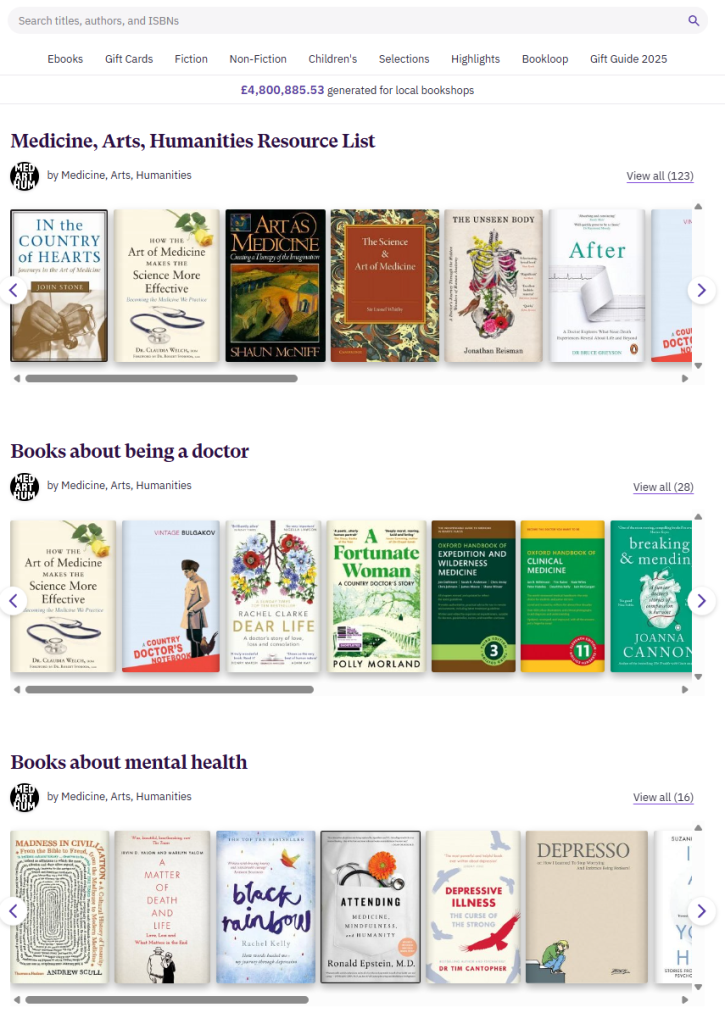
Browse the list and see where it takes you. Did you know, you can also visit our online bookshop and buy some of the titles featured in the Medicine, Arts, Humanities Resource List. Doing so supports local bookshops via Bookshops.org and also supports this site.
Screenshot of Medicine, Arts, Humanities Resource List bookshop
Browse the bookshop or seek out the titles in your local library. There are books about ‘being a doctor’, ‘mental health’, ‘medical humanities and art’, ‘graphic medicine’, ‘books for children’ and much, much more.
Coming soon… New & improved resource list and blog designed to stimulate research and help you explore the field of medicine, arts, and humanities. Stay tuned!
For my next spotlight feature into Medicine, Arts, Humanities resources I am going to turn to another of my early inspirations, Out of Our Heads (OOOH) – art in medicine online’ hosted by the University of Bristol Medical School.
The site, run by a group of GPs, educators, and developers shares over 500 artworks created by medical students, doctors, and patients.
You can search artforms, medical specialties, and medical diagnoses to find artworks reflecting your own interests or circumstances. There are a wealth of interesting artworks to explore.
Years ago, I was particularly drawn to a piece by Megan Fileman (2010) titled On the Outside. It is a sculpture, a figure in blue sat huddled under a glass as a figure in red peers in. Fileman accompanies her piece with a description. She writes;
… the sculpture is intended to illustrate the difficulty of giving support and comfort to someone when they are suffering, particularly when their experience is something that you can sympathise with but are unable to empathise with – because you yourself have not experienced it. (Fileman, 2010).
It struck a chord and I return to that image regularly. For me, it happens to capture the essence of my relationship with the field of medicine, arts, and humanities. My personal quest to try and understand my colleagues, who are medical professionals, who have endured trauma and experiences that I have not and will not. It’s a reminder too of the helplessness one can feel when someone you encounter is suffering in plain sight but is seemingly unreachable. You want to break the glass, but you cannot.
OOOH is linked to Bristol Medical School and “since 2004, medical students at the University of Bristol have been required as part of their core curriculum to submit creative works for assessment” (Thompson et al, 2010).
There are a number of medical school curriculums that embrace the arts and humanities. Bristol also appear to offer an intercalated BA in Medical Humanities, welcoming medical, dental, and veterinary students. Intercalated courses or creative additions to the curriculum offer students an avenue to explore their own learning and develop a wider skill base.
The academic discourse around medicine, arts, and humanities often attempts to justify and defend why this field is relevant and worthy of engagement. There are debates on what is included in the field too. Alan Bleakley, in Medicine, health and the arts: Approaches to the medical humanities, identifies four “contested and fragmented fields” and goes on to list them as:
The humanities studying medicine Arts and humanities intersecting with medical education Arts for health Arts therapies (Bleakley, 2014)
These fields can intersect somewhat and to me the OOOH project straddles a number of them.
So, what do the minds behind OOOH think and what do they believe it adds to the student doctor experience? Thompson et al write;
In terms of their future career as doctors, creative development may enhance their professional practice. Students will, for example, be engaging with complexity and uncertainty, facing new problems never encountered before, making sense of patient narratives and explaining diagnoses or lack of them, hopefully in ways that are useful to patients (Thompson et al 2010).
As noted, the collection of artworks on display at OOOH are vast and varied. The recent Covid-19 pandemic has been a prolific influencer of recent submissions that make for thought provoking content.
Linked below is a short film titled Disconnected (Saunders et al 2020) about the experience of using remote consulting during the pandemic.
Disconnected Saunders et al 2020
Another artist, Lydia Wells (2021) created a short film titled 10 Minutesthat illustrates some of the challenges of conducting ten-minute consultations in general practice.
Finally, I’ll highlight Beth Rooney, Katie Tan and Max Goldstone’s painting titled Sleep(2019) which articulates the strain and burden doctors bear.
Lots more to explore at outofourheads.net so I strongly encourage you to visit the site and explore them.
To be clear, I am in no way affiliated with the OOOH project or Bristol Medical School.
If you would like to explore more resources please browse the Medicine, Arts, Humanities Resource List. I have compiled a list that includes centres and associations, other resource lists, books, TV shows and films, graphic medicine, and more. The list is not exhaustive and resources are being added all the time. My hope is that you will use the list as a springboard for your own research, either as a medical professional, student, patient, or enthusiast.
You can search for keywords, you can browse by topic or filter by resource type. Check out the short tutorial here.
The list is hosted in Notion, but you do not need a Notion account to view it.
You can buy some of the listed books from our UK Shop via Bookshop.org. Link here Disclosure: If you buy books linked to our site, we may earn a commission from Bookshop.org, whose fees support independent bookshops.
References:
Bleakley, Alan in: Bates, Victoria et al (eds). Medicine, health and the arts: Approaches to the medical humanities. Routledge, 2014.
Fileman, Megan. On the Outside. Outofourheads.net, 2010
Rooney, Beth et al. Sleep. Outofourheads.net, 2019
Saunders, Izzy et al. Disconnected. Outofourheads.net, 2020
Thompson, Trevor, Lamont-Robinson, Catherine, Younie, Louise. ‘Compulsory creativity’: rationales, recipes, and results in the placement of mandatory creative endeavour in a medical undergraduate curriculum. Medical Education Online, 15:1, 5394, 2010
I believe it is appropriate that my first spotlight feature into resources from the Medicine, Arts, Humanities resource list is this one because this is where it started for me, where my interest in this varied and compelling field of medicine, arts and humanities was ignited.
In-training: Stories from Tomorrow’s Physicians (Vol1. 2016) is a collection of narratives written by medical students and edited by Ajay Major and Aleena Paul. The compilation includes essays and poems reflecting on a wide range of experiences the medical students endured during various stages of their medical training.
For me, as a non-medic, it was a window into a fascinating world that gave me an insight into how doctors think, the human struggle at the core of many medical interactions, systemic inequalities in healthcare, and the inner process an individual goes through to transition from student to doctor. For non-medics, in places it jolts and shocks the same way as Adam Kay’s popular This is Going to Hurt (2018) and it’s subsequent TV series does.
This is a valuable book for those studying medicine or considering it. The editors-in-chief, Major and Paul, state, “Our mission was simple: to create a virtual forum for medical students to record their thoughts about their lives as physicians in training” (2016).
They go on to say “Medical students craved a space for self-reflection, a space to express their innermost passions and their greatest fears about their chosen profession” (2016).
Each entry is followed up with a set of questions to help you, the reader, reflect on some of the themes or ethics raised by the author. Reflection is increasingly used as a learning tool in medical education. The General Medical Council (GMC) in the UK assert the following:
Medicine is a lifelong journey, immensely rich, scientifically complex and constantly developing. It is characterised by positive, fulfilling experiences and feedback, but also involves uncertainty and the emotional intensity of supporting colleagues and patients.
Reflecting on these experiences is vital to personal wellbeing and development, and to improving the quality of patient care. Experiences, good and bad, have learning for the individuals involved and for the wider system. (General Medical Council).
The reflections shared by students in this collection at times reveal vulnerability, compassion, worry, stress, and fear. They express some of the contradictions and personal struggles students face when assuming the role of the doctor in the doctor-patient relationship. They are compelling and honest.
Topics are varied and cover many aspects of modern medicine. The reflections are divided into chapters as follows:
Dissection Lab Learning Curve Work-life Balance From the Other Side Systemic Afflictions Our Patients Communication and Miscommunication Burnout Death and Dying Global Health Feeling Like a Physician
For me, there were many highlights in this book – my copy is filled with post it notes! From the very first entry, a poem by Lisa Moore called Hands (2013), to Navdeep Kang’s essay titled Medicine’s Hardest Lesson: People, Not Patients (2013).
And then there is Jennifer Tsai’s piece titled Breeze (2015) which opens with the following quotation which I think is somewhat pertinent in the world we find ourselves in, as I write this in 2022:
A woman once told me that babies cry at the slightest breeze because that is the greatest level of discomfort that they have yet experienced in their short lives. It is a reminder that we can persevere through life’s tribulations. That we grow from adversity. That new challenges make past trials smaller. That this, too, shall pass. (Tsai 2015).
I eluded earlier to the fact that it was this book that ignited my interest in the field of medicine, arts, and humanities. The writing in this collection is an example of how the arts, how writing for an audience, creates a connection with the human condition.
Medicine is a science, the human body is a network of systems, and illness management can follow medical pathways or surgical processes, however, the arts and humanities can be a powerful tool for articulating and translating the practice of medicine to its practitioners, to patients, and to those of us who take an interest. The realms of medicine, of life and death and all that is in between, can be reflected on, processed, cherished, and shared, all through engagement with the arts and humanities.
If you would like to explore more resources please browse the Medicine, Arts, Humanities Resource List. I have compiled a list that includes centres and associations, other resource lists, books, TV shows and films, graphic medicine, and more. The list is not exhaustive and resources are being added all the time. My hope is that you will use the list as a springboard for your own research, either as a medical professional, student, patient, or enthusiast.
You can search for keywords, you can browse by topic or filter by resource type. Check out the short tutorial here.
The list is hosted in Notion, but you do not need a Notion account to view it.
You can buy a copy of this book from our UK Shop via Bookshop.org. Link here Disclosure: If you buy books linked to our site, we may earn a commission from Bookshop.org, whose fees support independent bookshops.
References:
Kay, Adam. This is going to hurt. Picador, 2018.
Kang, Navdeep. Medicine’s Hardest Lesson: People, Not Patients. 2013, in Major, Ajay, Paul, Aleena (eds). In-training: Stories from tomorrow’s physicians. Pager Publications, 2016.
We have added a great new view option to the Medicine, Arts, Humanities Resource List that allows you to browse resources by topic/field. This utilises the ‘Group’ tool in Notion.
First, click the ‘View all resources’ drop-down menu.
Click ‘View all resources’
Next, select ‘View by Topic/Field’.
Click ‘View by Topic/Field’
Then, enjoy exploring the topic tags and the resources! I really want to expand on the number of tags to make this more useful and targeted – on the to-do list!
I am very excited to launch the Medicine, Arts, Humanities website and resource list.
I have worked in primary care education for over 15 years. During that time I have had the privilege of working with a great many inspiring medical professionals. I gradually became fascinated by the lives in medicine that my colleagues had chosen for themselves and in an attempt to understand them better I turned to the arts and humanities, as many people do when they are examining the human condition.
These disciplines not only help us to understand the people who choose to work in the medical profession but also offer a means for those same people to see how the profession and the outside world perceives them. The arts and humanities offer the medical profession both reflection and revelation, familiarity and new perspectives. Furthermore, the arts and humanities are being used to help professionals improve their consultations and patient care. They are being used in recovery pathways, in therapy, and applied for health benefits for both patients and professionals.
I created this list and website as a means of sharing the resources I found. I take no credit for the books, artworks, repositories, centres, and essays I signpost. My simple hope is that you will go on to find them, use them, and that they serve as a springboard for exploring your own research interests.




 Medicine Arts Humanities